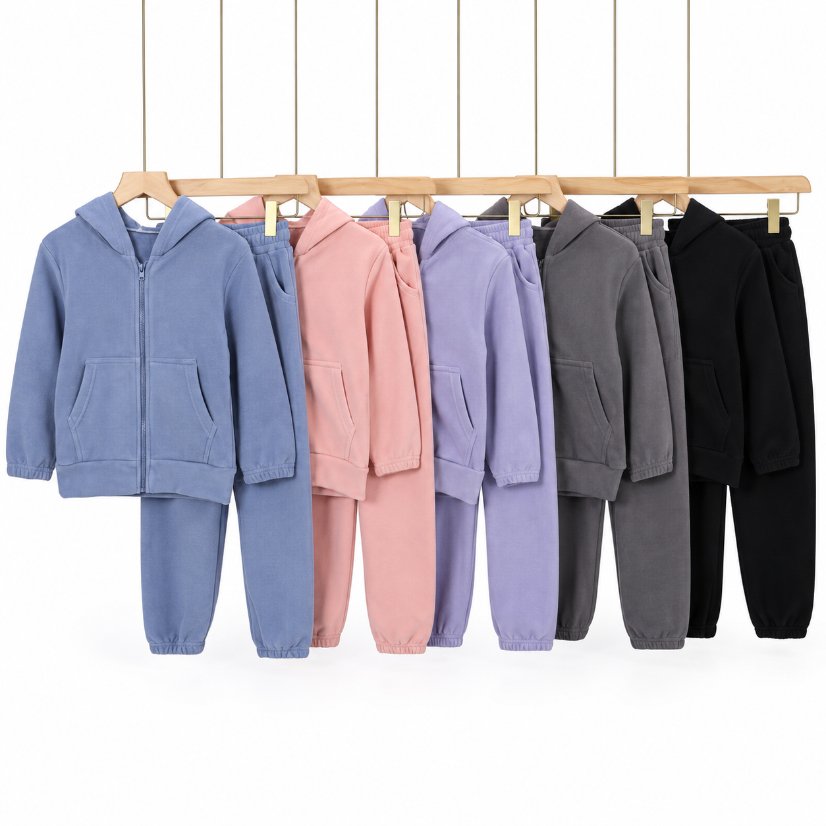
Before comparing quotations for a children’s clothing set, define one order unit as a written list of included pieces. State whether the quoted quantity means complete top-and-trouser sets or individual garments, then ask the supplier to repeat that unit in its quotation. Tianhong Pants describes its Kids’ Clothing Set as a hooded two-piece set with cuffed long pants. That provides a starting reference, but your enquiry still needs to connect the named pieces, selected version and quantity to the offer you receive.
Make the word set commercially precise
A set description should identify each included garment and any separately charged item. For the pictured product, ask the supplier to confirm that the proposed unit includes the named top and trousers together. If your retail presentation also needs a hanger, insert, bag or other accessory, list that as a separate requested packing component. Do not assume those items are included because garments are shown hanging in a catalogue photograph. A clear unit definition lets your purchasing and receiving teams interpret the same quotation without making different assumptions.
Write the quantity in both unit and component terms where that will prevent ambiguity. For example, a request for a stated number of complete two-piece sets can also identify the corresponding number of tops and trousers. Keep the example quantity as your requested quantity, rather than a supplier minimum or promise of availability. Ask whether the supplier can quote the required pairing as one commercial line, and ask how any proposed alternatives will be described. An offer for separate garments should remain visibly separate from an offer for complete sets.
Identify the version behind the quoted unit
Use the product-page link and a labelled reference image to identify the starting style. The Tianhong page lists colour options and size labels, but those details do not replace a version-specific offer. Ask which colours and sizes are available for quotation now. Provide your requested selection in a matrix and give each combination an item reference. If the supplier proposes a substitute colour or a different top or trouser detail, ask for a revised reference rather than treating the change as covered by the same general product name.
Keep size labels separate from age assumptions. The page displays labels such as 110, 120 and 130, but a label alone does not define garment measurements or establish suitability for a particular child. Request the supplier’s measurement chart and method for the quoted version. You can then decide how that information fits your assortment and retail communication. Material composition, care information and any required product documentation should likewise be requested for the specific offer, rather than inferred from the photograph or from general catalogue language.
Use a unit-definition table in the enquiry
Order field | Buyer instruction | Confirmation to request
Commercial unit | Complete set or individual garment | The same unit on every quoted line
Included garments | Name the requested top and trousers | Exact pieces supplied per set
Version identity | Product link and reference image | Offered style reference and differences
Colour and size | Requested combination matrix | Quoted options and item references
Packing components | List each requested accessory | Included items and separate charges
Quantity statement | Units plus component cross-check | Totals by set, garment and carton
The table is useful when offers come back in different formats. One supplier may quote per set while another quotes each garment separately; a freight or packing estimate may use yet another unit. Bring each response back to your requested definition before comparing commercial totals. Ask for clarification if a line simply says pieces. Do not silently convert an ambiguous quotation into sets. The supplier should confirm whether its stated number refers to completed paired units, individual tops, individual trousers or some other packing unit.
Connect the set definition to receiving
Decide how paired items should be identified when they arrive. A complete retail set may need a common item reference on its packaging, while bulk-packed garments may require a separate top-to-trouser pairing list. Ask the supplier to describe the proposed packing method and provide a sample or diagram. A retailer distributing to UK and EU stores, for example, can use the same unit definition while requesting different label languages or commercial artwork. Applicable destination requirements still need their own review; a catalogue listing does not establish compliance.
Before placing the order, check that the final quotation, approved sample reference and packing proposal all describe the same unit. Record how changes to one component will be handled and whether a changed top or trouser requires a new item reference. For repeat purchases, refer to that complete specification rather than sending only an old photograph. Request current pricing, minimum quantities, timing and stock information for the defined version. Those commercial terms remain open until confirmed, even when the product is visible on the website.
FAQ
Does two-piece mean packaging accessories are included?
No such inclusion should be assumed. Ask which garments form the two-piece unit and list any hanger, bag, insert or label you want quoted. The supplier should distinguish included components from optional packing requests or separately charged items.
How should a quotation using pieces be handled?
Ask the supplier to define the term before comparing totals. It may refer to individual garments or complete paired sets. Request the number of tops, trousers and complete order units explicitly so the meaning is consistent across the commercial documents.
Can size labels be converted directly into ages?
Do not make that conversion from the labels alone. Request the measurement chart and its measurement method for the quoted version. Use verified product information when preparing your own size guidance, and keep any age-related or safety statements subject to appropriate review.
What should the first sample request include?
Provide the product reference, selected colour and size combination, the requested set definition and the packing format you want evaluated. Ask the supplier to identify the sample version and disclose any differences from the proposed bulk offer before you approve the reference.
Product reference and enquiries
Product reference: https://tianhongpants.com/product/kids-clothing-set/
Catalogue source: https://tianhongpants.com/
Contact Tianhong Pants: https://tianhongpants.com/contact/
More buyer articles: https://tianhongpants.com/blog/